SS Wire Braided PTFE Hose Pipe Manufacturers, Suppliers in India


Stainless steel braided PTFE hoses are one of the top picks today in the markets. Their popularity in the market helps them distribute gasses and liquids with ease.

The versatility of braided PTFE hosescannot be ignored and they have transformed modern living and business. The area number of sizes and types and can be found everywhere right from manufacturing plants to homes. Still wondering which hose assembly pipe to choose? Then you may certainly choose PTFE braided hose.


Check out the reasons why you should select PTFE braided hoses in your manufacturing hoses. 


  • Braided PTFE hose is strong and durable
  •  PTFE hose pipe is composed of woven stainless steel reinforcement and people prefer it over the regular hose tubing. This reinforcement builds overall strength of the pipe.
  •  The Braided PTFE hose can function optimally well under high pressure
  •  PTFE braided hose. surpasses most other hoses as they perform well under high pressure.
  • The Braided PTFE hose is temperature resistant 
  • Most hose pipes transform under the condition of extreme weather conditions, but it is different with PTFE braided hose as it offers more resistance to chemicals available in the market today.

 Resistant to most chemicals

PTFE braided hose is also resistant to some of the chemicals that are available in the market today. The only exceptions to the rule are molten alkali metals and halogenated chemicals which makes this kind of braided perfect for different kinds of manufacturing. 

PTFE braided pipes are an integral part of the food and beverage industry
Even moisture cannot impact this kind of pipes. PTFE also does not impact the smell, taste, or color of any chemicals and hence has got the stamp of approval by the FDA.
offers security against fire
PTFE braided hose assemblies are offered protection against fire and thus are and hence are chosen for fire extinguisher systems and pressure gauge lines. The hose can also be further protected from high heat environments as a heat sleeve is provided over the stainless steel braid reinforcement.

Braided PTFE hose is very flexible
The reinforcements in the stainless steel braids help in the utilization in motion and vibration processes enhancing its durability. The hose can easily be bent which depends on the size and the overall construction: smooth-bore, convoluted and, or outer covers.

Braided PTFE hoses provide unsurpassed cleanliness
The chemical compounds within PTFE braided hoses are completely resistant to sticking, and hence they are resistant to damage from the chemicals that it transports.

What are the styles of PTFE available in a Mechanical Industry Company?


A majority of industries including the steel Industry and chemical processing industry use consistently utilizing pipes composed of fluoropolymers and mainly PTFE hoses are utilized to make these pipes. This kind of pipes is largely used to carry chemicals which are highly reactive or corrosive. The popularity of these pipes is such that gradually carbon- made pipes and another kind of pipes are slowly being replaced with PTFE tubing.


The Properties of PTFE Tubes 

The PTFE tube properties are drastically different from other pipes and the popularity of the pipes is huge because of its unique properties. The important PTFE tube properties are as follows. The unique properties fulfill the needs of the different industries right from mechanical industries company to chemical industries. 

·         Thermal properties- PTFE tubing can withstand very high temperatures, in fact it can withstand temperatures as high as 680 °F for a stipulated period under cryogenic conditions; Here the pronounced properties of PTFE tubes do not waver even when it is brought under high temperatures such as 500 degrees Fahrenheit and that’s not all it can withstand extremely cold temperatures too even when it is down to -320 °F.

·         Electrical properties- PTFE tubing has impressive electrical properties as it is a great insulator and has competent insular properties.

·         UV resistance and wearability- PTFE tubing boasts of superb UV resistance and wearability.
·         Wear and Friction Qualities- The surface of  PTFE tubing is relatively slippery and smooth and thus it boasts of great wear and frictional qualities.

Usage of PTFE Tubes

 The success of PTFE tubing is largely dependant on the unique properties and that is why it is used in a large number of industries. The PTFE uses and Properties are as follows:

In automotive applications, the property of PTFE has the property of withstanding high temperatures that are more than 250degreesC and hence is perfect for highly corrosive fluid transfers and hence PTFE tube suppliers consider it an integral part of their industries.

The medical industry cannot do without PTFEtubes either because of its lubricity and chemical inertness. One such example is that of catheters which are deemed safe to insert in human bodies too. That speaks a lot of the dependency of the medical industry on PTFE tubes.

PTFE tubes are a must-have in laboratories and have the power and the potentiality of replacing the use of glass tubes. The qualities which make PTFE tubes indispensable is its inert properties and also the fact that it is very durable.

In electrical applications, the PTFE tubing is set apart because of the dielectric properties that make it particularly suitable for the process of insulation of high voltage cables.

The PTFE properties are also used in mechanical industries which makes bearing pads, under extreme conditions such as high pressure-low velocity load conditions. Some examples to note here are pipe support pads, bridge bearing pads, and mounting pads for some heavy duty manufacturing.

Check out some of the short list applications:

  • Heat exchangers
  • Coatings
  •  Non-Shrink & Heat Shrink Tubing
  •  Carburetor Shafts
  •   Mold release
  •   Medical Catheter Guide Wires
  •  Automotive brake parts 
  •   Jet fuel filters 
  •   Cryogenic Applications
  •   Bearing Pads

No wonder the uses and importance of PTFE tubes are hitting the roof thanks largely because of its unique properties.

PTFE Tube (Teflon Tube) with Various Grades and sizes


PTFE Teflon Tubing (PolyTetraFluoroEthylene(PTFE) a fluoropolymer tubing, and described as Teflon tubing). It is transparent, chemically inert and non-toxic material and offers unmatched chemical resistance and a surface that really eases the flow. Due to its high flexibility, PTFE is particularly used with microfluidic fittings in low-pressure applications. Its melting point is reached at 327°C, making it a great choice in high temperatures. 


PTFE tube includes:

Spaghetti tubing – It has a wall thickness of within 1.5mm and an outer diameter of less than 15mm, this tubing can be largely used in medical and automotive applications.

PTFE hoses – These are heavy-wall thickness tubes and are used particularly in applications that require high-burst pressures or heavy insulation.

PTFE sleeves – These type of  PTFE  can be either extruded or compression-molded. Their wall thickness varies between 2-6mm, but the diameter could go up to as much as 300mm. Sleeves are used in a large number of applications that require lubrication,  insulation, corrosion resistance, or load bearing.

The Advantages of PTFE

 PTFE  boasts of a wide number of applications. The benefits of PTFE is that it can be used in both manufacturing and engineering purposes, for making tubes or liners and for handling or storing corrosive chemicals, also for the purpose of coating bearings or screws to increase the shelf life of both the parts themselves and increase the shelf-life of the machinery they are a part of.

A PTFE-coated screw will be corrosion-free, as PTFE has the characteristic of repelling  water and oil, and is also lubricated by the material to smoothly drive into the surface that it is fastened to, with reduced friction, and thus resulting in less wear and tear of the screw and the surface, and a secure and long-lasting finish.

A PTFE coat has the benefits to screws, as it coats the screw it also makes it heat-resistant.

It’s true that parts that are particularly high can bring about efficiency in the machinery and reduce the instances of replacing parts, so it saves money and time and drastically reduces waste. This will further reduce maintenance needs and any expensive manufacturing downtime as a result of faults or repairs.

Equipment-cleaning can be drastically reduced in a few cases as a PTFE coat is non-wetting, thus facilitating self-cleaning of parts. Teflon is also environment-friendly because, when it is applied to fabric, the finish will repel water and also oil stains which minimizes the need to use dry cleaning, and fabrics that dry up more quickly, with less energy with tumble drying, and it also lasts longer due to less wear and tear.

 PTFE is non-toxic,  apart from the fumes emitting from Teflon-coated pans that reach above 260 degrees C. It is also FDA approved and food-safe, so this material offers many benefits and can be used in many different areas.


PTFE Tubing - PTFE Tubing Products Manufacturers In India


The Chemical Processing Industry and the Steel Industry have been using fluoropolymer tubing products, for many years, from materials like PTFE and hoses. Fluoropolymer tubing products are used for transferring highly corrosive and caustic chemicals. It is true that PTFE tubing is used more and more for replacing other metal piping such as carbon that deteriorates rapidly. PTFE is now the most sought after tubing and is considered to be the tubing for the future and is being used for a number of critical applications.

When is PTFE Tubing used?

PTFE tubing can be especially utilised when the temperature needs to be above 500º F (260º C) then PTFE Tubing is considered the recommended choice. The reason why it is suitable for high temperatures is that it resists “melt-off” with the help of soldering irons when making the right terminations. 

The fact that it has excellent dielectric properties, it can be used in a number of electronics and electrical services. Another key advantage of the PTFE Tubing is that it has non-stick properties that can help in the transport of materials that too without maximum fluid resistance. But there are something’s which you need to be wary of and that is PTFE reacts with molten sodium hydroxide, fluorine and molten alkali metals. The chief PTFE Tubing properties that PTFE tubing manufacturers boast of are the following,

  • Non-stick properties
  • Aging resistance
  • Temperature resistance up to 260º C (500º F)
  • Superior chemical resistivity and low coefficient of friction
  • Can be chemically sterilized in-line or steam
Ong PTFE.jpg

PTFE Tubing Applications:
PTFE Tubing has numerous applications on industries such as Electronics, Components & Insulators, Aerospace &Transportation, Electronics,Food Processing, Chemical & Pharmaceutical Manufacturing, Air Sampling, Environmental Sciences, Fluid Transfer Devices and Water Processing Systems.
Here are some of the key features of PTFE tubing which makes investing in OTFE tubing absolutely worth it.

Thermal Qualities:
PTFE tubing can withstand high temperatures as high as 680 °F for limited periods of time. Put under cryogenic conditions, PTFE can withstand up to -320 °F.
 But above 500 °F, mechanical properties then becomes a limiting factor.

Electrical Features:

PTFE tubing has great electrical properties as well, as it indicates a low dielectric constant which ranges from 2.1 between -40 °F and 480 °F within a stipulated frequency range of 5 Hz to 10 GHz.
That’s not all PTFE tubing also has excellent insulator properties which has asurfaceresistivity of 3.6 X 10¹² ohms and that too even at 100% relative humidity.
The shirt time dielectric strengths can range from 500 volts/mil (1 mil = 10-3) this is for thicknesses which is greater than 100 mils to 4000 volts/mil for very thin films.

UV and Radiation Features:

PTFE tubing also has excellent UV resistance and weather ability, which for PTFE hoses, has a radiation dose threshold at 2 – 7 X 10⁴ rads. The absence of oxygen shoots up the radiation resistance by a factor equalling at least 10.
The resistance to electron and gamma radiation is comparatively poor.

Wear and Friction Features:

PTFE tubing’s surface is relatively slippery and smooth with a static coefficient of friction ranging from 0.08 and 500 psi load.

The above features of PTFE Tubing and its wide ranges of applications make it a perfect tubing to be used in a number of industries.

The Advantages of PTFE in Demanding Filtration Applications


In today’s highly competitive world there are companies that are moving into higher value-added chemicals and materials. Further, environmental regulations are increasing the stringent rules as governments at the national, state and local levels are requiring that industries control pollution by limiting emissions. Thus there is a quest to limit those wastes and emissions. In this competitive environment, the filter end user, filtration design engineer or filter end user will require material to increase the performance and durability. This shows that the polytetrafluoroethylene  PTFEtube is well suited to cater to the multitude of these demands and help the industry to meet the many environmental obligations.


PTFE OVERVIEW

PTFE was discovered by Dr. Roy Plunkett at DuPont in 1938. Earlier it was limited to wartime applications until after World War II when it was first introduced under with the trademark Teflon. Today, there are a number of suppliers which offers 60,000 tons/year. Where the large fluorine atoms form a sheath around the carbon backbone, providing it from attack from organic, acid, or base solvent, except at elevated temperatures. This sheath also imparts low surface energy and providing a very low coefficient of friction (< 0.1) and nonstick properties. This low surface energy renders PTFE hose both hydrophobic and oleophobic, so neither the aqueous nor oily materials adhere to it. Thus, it is really easy to mechanically remove any dust or filter cake which gathers on the surface. 

PTFE monofilament or thread is fit for filter manufacture either as:
Talking about a sewing thread specific for sewing filter bags of PTFE or made for high-performance fibers that are used in hot gas filtration, such as baghouse filters found in the stacks of coal-fired boilers, cement plants and so on. 

As a woven scrim for needle punching PTFE or other high-performance fibers to form the fabrics that are utilized in baghouse or other filter formats.

A filament for wound-core filters is used for corrosive liquid filtration applications.
All of these applications tap onto the superior chemical resistance and offers an excellent heat resistance of PTFE.

Is PTFE is Moldable

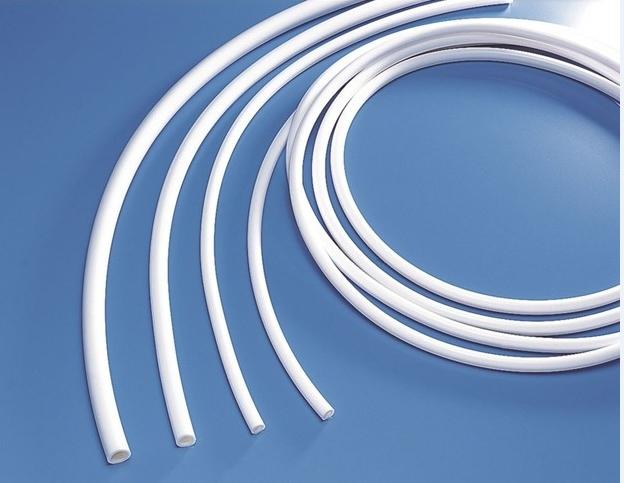
PTFE tubing provides a perfect blend of commercially available and high performance tubing. PTFE tubing typically means flexible tubing with wall thickness from 0.5 to 2 mm. PTFE tubing with wall thickness more than 2 mm is rigid and is called a PTFE tube or PTFE pipe. Generally PTFE tubing appears to be milky white to translucent however PTFE tubing can also be manufactured in many colours. PTFE tubing with high transparency is desirable in many applications as the visibility of the fluid flowing through the PTFE tubing is a key factor. It is also possible to manufacture PTFE tubing having electrical conductive properties or having enhanced resistance to abrasion.

ptfe tubing


PTFE tubing are usually connected to machines, equipment or supply lines using metal or connectors manufactured using other Materials like PEEK and PVDF.  So that the connections are leak free it is important that the PTFE tubing are manufactured with tight tolerances. Advanced Fluro Tubes manufactures PTFE tubing with dimension  tolerances  as low as 50 microns. Dimension tolerance for PTFE tubing depends on the ID and OD of the PTFE tubing. There are many secondary operations that can be done on PTFE tubing like flanging, flaring, cutting, spiral cuts, braiding etc. When braided the pressure rating increases many folds and bend radius decreases. PTFE tubing can be braided using stainless steel, polyester and aramid fabric to suit the application. PTFE tubing has a density of 2.15 – 2.18. PTFE tubing density is very important as it tells us about the performance we can expect of this PTFE tubing.

Dielectric strength of PTFE tubing is 18 to 24 kv/mm. This parameter is important for electrical applications. This parameters basically tells us how much voltage will be insulated by PTFE tubing before it breaks down as an insulator. The higher the value to better. A value less than above mentioned range could indicate a issue in the manufacturing process or use of PTFE raw material not suited for high voltage electrical applications.Percentage elongation at break of PTFE tubing varies from 200 to 400%.

PTFE tubing should have a smooth Internal diameter as they are used to transfer highly viscous fluids. When the ID of the tube is not smooth the viscous fluid tends to “stick” to the tube wall and eventually clogs the tube. Smooth ID is also important to food grade application. Smooth interval diameter of PTFE tubing prevents bacterial buildup. PTFE tubing in smoothbore form is flexible however as the dimensions increase the flexibility decreases. Often when used in tight spaces PTFE tubing cannot bend as per available space. To solve this problem PTFE tubing is convoluted. Convolutions ensures the bend radius is reduced and PTFE tubing can be bent and fitted in small spaces.

PTFE tubing has a milky white to translucent appearance. There are application where visibility of the fluid is important to spot contamination for example or to check for deposition on PTFE tubing ID. For such applications increased transparency is required. Advanced Fluro Tubes can manufacture PTFE tubing with increased transparency.There are instances where an industry has specifications for colors of tubing that can be used for specific applications. Advanced Fluro Tubes manufactures PTFE tubing in many colors like red, blue, yellow, green, orange and black.

Antibacterial application require that the ID and OD of the PTFE tubing is very smooth and shiny. This ensures there is no entrapment of fluid and material reducing deposition of material. Material deposited on rough surfaces is difficult to clean using insitu steam cleaning. This eventually causes bacteria build up. The deposited material also reduces the flow and adversely affects the performance of the system.

PTFE tubing is generally supplied as coils however can also be supplied as cut pieces or cut lengths.Some applications demand that PTFE tubing be rigid while others requires more flexibility.  PTFE tubing are manufactured in continuous lengths upto 400 mtrs. It is therefore important to test for leakages via pin holes not visible to naked eyes.