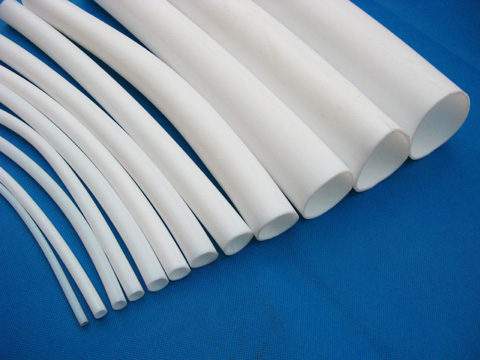
PTFE or Polytetrafluoroethylene is a versatile plastic material, ivory-white and opaque fluoropolymer; it is composed of free-radical polymerization of a host of tetrafluoroethenemolecules and can be used for a huge number of applications in varied industries such as the food and drink industry, the telecom industry and the pharmaceuticals.
The Chief Properties of PTFE
PTFE is a flexible, thermal resistant,
chemical resistant, non-stick and also electrically resistant material with its
melting point being around 327°C, and pure PTFE has high flexural
strength, even in very low temperatures, high dielectric strength and
electrical strength. Potentially high resistance to water and fairly low
coefficient of friction. PTFE’s density ranges from
the 2200 kg/m3 mark.
The only con is that it may have a reaction to chemical agents and solvents such as chlorine trifluoride, xenon difluoride, cobalt (III) fluoride, or elementary fluorine if put through under high pressure and temperature conditions. PTFE also does not have a good resistance to high energy radiation, which forces the breakdown of PTFE molecules.
The only con is that it may have a reaction to chemical agents and solvents such as chlorine trifluoride, xenon difluoride, cobalt (III) fluoride, or elementary fluorine if put through under high pressure and temperature conditions. PTFE also does not have a good resistance to high energy radiation, which forces the breakdown of PTFE molecules.
A
Few Modified Features of PTFE
Besides PTFE, there are some of the two copolymers which are almost as useful as PTFE,
but with some different properties.
PFA or Perfluoroalkoxy has almost similar properties of PTFE as it is flexible, very chemically resistant and thermally stable and can be used up to 260 degrees C even if PTFE has the properties of being able to creep, PFA is creep resistant and is used for a number of properties such as extrusion, melt-processing, injection moulding, transfer moulding, compression moulding and blow moulding.
TFM, better known as PTFE-TFM, is polytetrafluoroethylene with perfluoropropylvinylether taken as an additional modifier, boasting of a material which is stiff being creep-resistant like PFA, and weldable.
PFA or Perfluoroalkoxy has almost similar properties of PTFE as it is flexible, very chemically resistant and thermally stable and can be used up to 260 degrees C even if PTFE has the properties of being able to creep, PFA is creep resistant and is used for a number of properties such as extrusion, melt-processing, injection moulding, transfer moulding, compression moulding and blow moulding.
TFM, better known as PTFE-TFM, is polytetrafluoroethylene with perfluoropropylvinylether taken as an additional modifier, boasting of a material which is stiff being creep-resistant like PFA, and weldable.
Advantages
of PTFE
Advantagesof PTFE ,There is no doubt about the fact that PTFE
is indeed very versatile and has a huge
number of applications to speak of.
It is especially used in manufacturing and engineering, it is not limited to using in tubes or liners or for handling or storing corrosive chemicals, but it is also used in parts such as bearings or screws to increase the lifespan of the parts and also the machinery it is part of.
It is especially used in manufacturing and engineering, it is not limited to using in tubes or liners or for handling or storing corrosive chemicals, but it is also used in parts such as bearings or screws to increase the lifespan of the parts and also the machinery it is part of.
The longer lasting, higher-performance parts ensure that it enhances the efficiency of any machine it is part of, thus reducing the requirement of constantly replacing parts, which leads to saving money and reducing waste. Hence it will cut down on constant maintenance issues with the equipment which will lead to the reduction of any expensive manufacturing downtime due to the repairs and faults.
PTFE coat is non-wetting, thus felicitating self-cleaning which again reduces the cost of frequent cleaning.
Teflon textile finishes are environment-friendly because the finish repels water and oil stains, and reduce the requirement of dry-cleaning and fabrics will also tend to dry up quickly, using far less energy with methods as tumble drying, and with the reduction of wear, it also tends to last longer.
The above-listed properties of PTFE quite explain why it is one of the most sought-after pipes and tubes catering to the needs of most of the industries.
more details about : https://www.aftubes.com/

